

Why some of your most important financial decisions happen long before retirement
Most federal employees hire an advisor when retirement is near—usually in their late 50s or early 60s, when the decisions feel big, complicated, and irreversible.
That makes sense. But it also misses something crucial:
There are mid-career and even early-career “flex points” where good decisions can create six-figure improvements in your future retirement.
And most federal employees don’t know this.
Below are the three areas where smart planning in your 30s, 40s, and early 50s can make an enormous difference:
- FEGLI selection & alternative “permanent” life insurance investment
- TSP asset allocation & safe-savings-rate
- TSP tax planning (Traditional vs. Roth)
Let’s walk through why these matter—and why mid-career is your golden window to get them right.
1. FEGLI: Your Need Declines Over Time… and the Cost Goes Up
Early in your career—especially if you have young children, a mortgage, and decades of earnings ahead of you—your “human life value” is at its highest.
In simple terms, human life value is the idea that your future earnings, and the life you are building for those who depend on you, represent a large financial asset. Life insurance exists to protect that asset.
But here’s the problem:
As you age, your need for life insurance gradually goes down… as FEGLI becomes prohibitively expensive.
And unlike private permanent insurance, FEGLI builds no cash value.
You can pay thousands of dollars over the years and walk away with nothing.
The Best Time to Buy Permanent Life Insurance? The Sooner the Better—Not Retirement
There is a reason permanent life insurance is least appealing when it is most financially rewarding:
- Every 35-year-old feels invincible
- Mortgages are long, careers are strong, kids are young
- And life insurance feels “boring” compared to other investments
But boring does not mean bad.
In investing, boring is often best.
Just like the best time to buy stocks is when everyone else is panicking, the best time to purchase permanent life insurance is when you are young and healthy and the premiums are low.
In my career, I have never met a federal employee who bought a permanent life policy in their 30s or 40s and later regretted it.
But I have met many who reached their 50s or 60s, desperately wanted a permanent policy, and regretted not acting earlier—when the premiums were a fraction of the cost.
There’s a lesson there.
Permanent coverage is also the foundation for a Pension-Maximization Strategy, which can be incredibly valuable for federal retirees. (We’ll cover that in a separate, dedicated article.)
2. TSP Planning for Mid- and Early-Career Feds: The Three Big Decisions
Your TSP is an extraordinary tool when used the right way. My clients who retire with $1 million or more consistently do the same things during their working years:
They use the TSP for its strengths—not its weaknesses.
The TSP is not an F1 race car—it’s a Mack Truck.
It is not designed for day-trading, timing the market, or frequent adjustments.
It is designed for long-term, disciplined, evidence-based investing.
And there are three critical decisions every mid-career employee must make:
- Asset Allocation (set it and forget it)
- Safe-Savings-Rate (SSR) (set it and forget it)
- Tax Planning: Traditional vs. Roth (review regularly)
Asset Allocation: Why a 1% Difference Can Mean Hundreds of Thousands
Most DIY investors pick funds that did well recently and assume they’ll continue to do well.
Unfortunately, that approach fails more often than it succeeds.
Professional asset allocation is different. It’s based on:
- Long-term evidence
- Diversification principles
- Risk/return modeling
- Avoiding behavioral mistakes
- Matching the strategy to your retirement timeline
Over 20–25 years, even a 1% difference in average return can mean:
- $100,000+ more in a typical TSP
- $300,000–$500,000 more for high savers
This is why setting a smart allocation in mid-career is so powerful—it compounds for decades.
Safe-Savings-Rate (SSR): How Much Should You Actually Be Saving?
Your Safe-Savings-Rate is the amount you need to save each year so that, when combined with your asset allocation, you reach retirement with the income you want.
Most people pick a number that “feels right.”
Professionals calculate a number that is right.
SSR depends on:
- Your age
- Your expected retirement lifestyle
- Your years of federal service
- TSP performance assumptions
- When you plan to retire
- Whether your spouse will retire similarly
For many employees, adjusting their savings rate by as little as 1–3% of salary today can add six figures to their retirement balance.
And the earlier you implement it, the more powerful the compounding becomes.
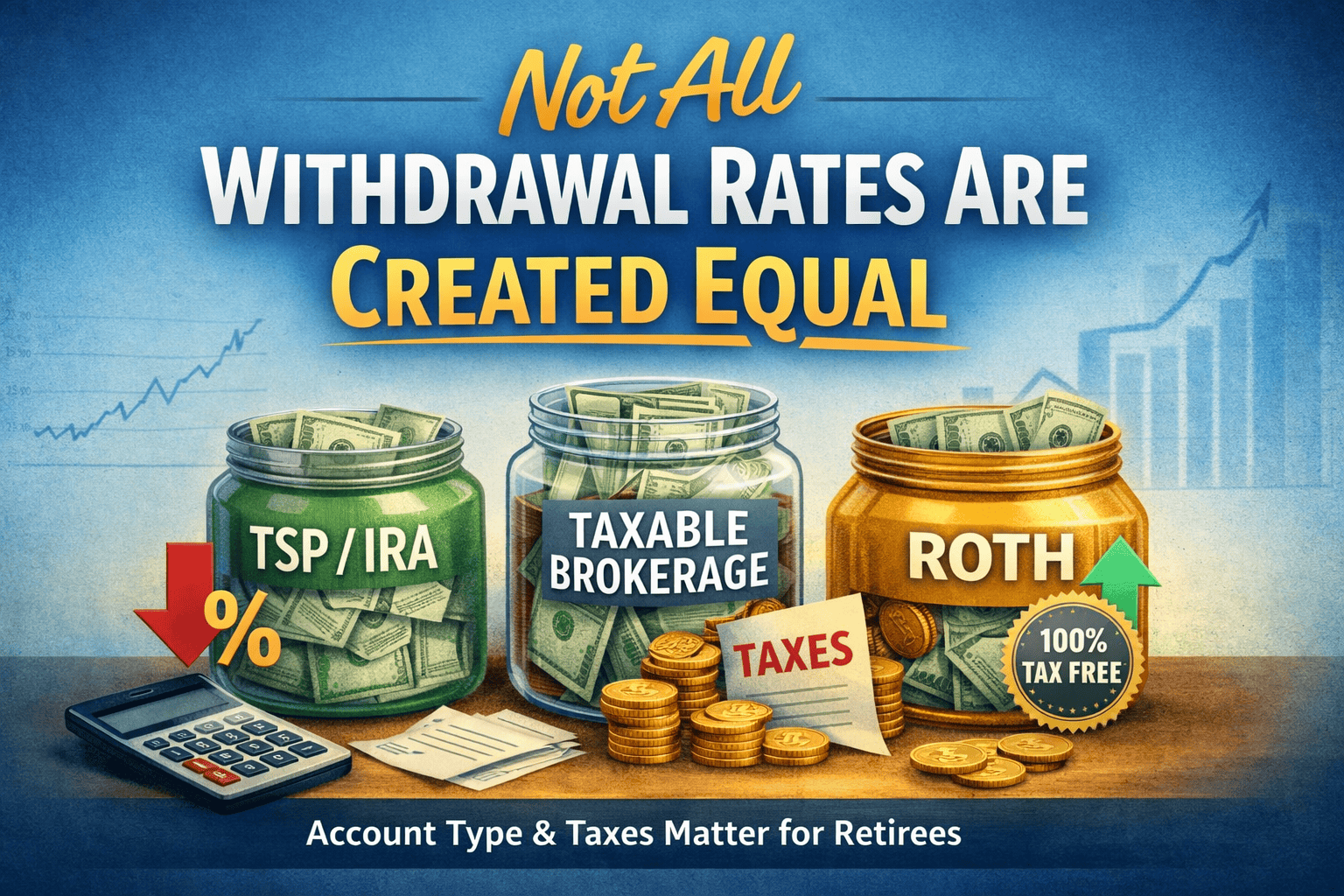
3. Tax Planning Inside the TSP: Traditional vs. Roth
This decision changes as your career evolves.
Early in your career, your tax bracket may be lower—making Roth more attractive.
Later in life, Traditional contributions may become more compelling.
Your marital status, ages of children, deductible debt, future pension, Social Security timing, and planned retirement income strategy all affect the optimal choice.
This is one area that requires regular review, because your tax landscape changes with your career.
The Bottom Line for Mid-Career Federal Employees
Most people wait until retirement to hire a planner.
But the financial decisions you make in mid-career may matter just as much—and sometimes more.
- FEGLI and permanent coverage decisions are far more affordable now than later.
- Asset allocation decisions made today compound for decades.
- Your safe-savings-rate is one of the biggest drivers of future wealth.
- Tax planning inside the TSP is most powerful when done early and reviewed often.
At Better Federal Retirement, we offer custom TSP Asset Allocation + Safe-Savings-Rate recommendations for only $300.
If a smarter strategy today could mean:
- $100,000 more in 20 years
- $300,000 more in 25 years
- Or even $500,000 more over your career…
Is $300 today worth it?
Get Personalized Mid-Career Guidance
You don’t have to guess. We’ll help you make informed decisions about FEGLI, permanent coverage, TSP asset allocation, your safe-savings-rate, and Traditional vs. Roth strategy—so your future self can thank you.
Important Disclaimer: This article is general in nature and is not individualized financial, tax, or investment advice. By definition, true advice can only be given in a one-on-one setting after reviewing your specific situation, goals, and federal benefits. Before making any major financial decisions, please consult with a qualified fiduciary advisor or tax professional. If you would like personalized recommendations, we invite you to schedule a call using the button above.




Leave a Comment