
Roth Conversion Planning for Federal Employees
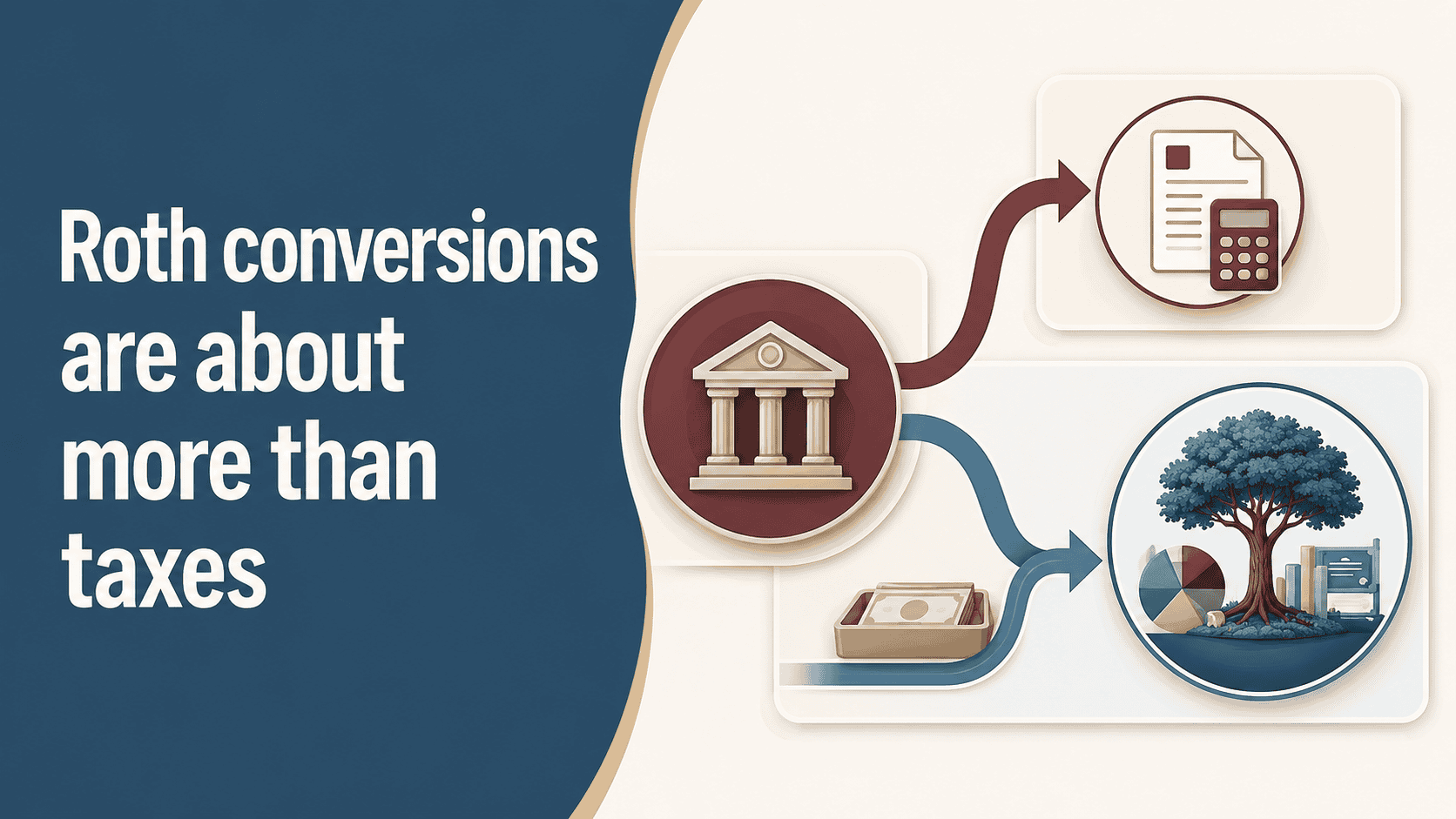
Roth conversions are usually evaluated as tax strategies. But they can create another important benefit—one that rarely has a name.
Ask most investors why they would consider a Roth conversion, and the answer is straightforward: taxes.
You pay income tax on the conversion today in exchange for tax-free growth, tax-free qualified withdrawals, and fewer required minimum distributions later. When the strategy is well designed, that trade can reduce lifetime taxes and give a retiree more control over future taxable income.
That is the familiar benefit. But it is not the whole story.
A Roth conversion can also reduce the number of times long-term retirement assets are turned into cash—and then depend on someone taking another step to put that money back to work.
This has no standard name, surprisingly, but we will call this the staying-invested benefit.
That principle sounds obvious. In retirement, however, required distributions, account rules (particularly TSP rules), taxes, and ordinary human behavior can make it surprisingly difficult to follow.
One Strategy, Two Different Benefits
A Roth conversion can create two distinct kinds of value:
| Source of value | What creates it | The question it answers |
|---|---|---|
| Tax-planning benefit | Paying tax at a deliberately chosen time, reducing future tax-deferred balances, and creating tax-free assets | Is paying tax now likely to improve the household’s long-term tax outcome? |
| Staying-invested benefit | Reducing future distributions that turn invested assets into cash and require another decision | What is likely to happen to money the retiree must withdraw (such as RMDs) but does not need to spend? |
These benefits often appear together in a financial projection. If the no-conversion scenario assumes that future RMDs accumulate in cash while the conversion scenario leaves more money invested in Roth accounts, the conversion scenario may finish with substantially more wealth.
That result is not necessarily wrong. Both outcomes may be realistic.
The mistake is describing the entire difference as a tax benefit. Some of it may come from better tax treatment. Some may come from keeping more of the household’s money invested. Those are different sources of value and should be explained separately.
This is not a software problem. Planning software calculates the assumptions an advisor gives it. It is the advisor’s responsibility to understand what is driving the result and explain it honestly.
What Happens After an RMD Arrives?
Required minimum distributions are designed to move money out of tax-deferred retirement accounts. They do not require the retiree to spend that money.
If an RMD is needed for living expenses, turning investments into cash is appropriate. The money is doing its intended job, because you’d spend it anyway.
But many federal retirees have pensions and Social Security benefits covering much of their regular spending. Your RMD may (and likely will) exceed what you need. Once that excess money leaves the retirement plan, one of several things can happen:
- It can be reinvested promptly in a taxable brokerage account (ideal, but rare).
- It can remain in a bank account or cash sweep (most common, and unfortunate).
- It can be reinvested only partially or after a long delay (even a week non invested has its costs).
- It can gradually become part of ordinary spending, even if that was never the original plan (a short-term view, with long-term consequences: if it’s in your bank account, why not spend it?).
The last three outcomes are not exotic modeling assumptions. They are ordinary human outcomes. Every additional step creates another opportunity for delay, inaction, or unplanned spending.
The behavior is measurable
Vanguard found that 28% of investors who completed IRA rollovers still had the rollover proceeds in cash after one year. Assets still in cash after that first year tended to remain there for at least seven years.
A separate study published in the Journal of Financial Economics found that investors’ willingness to reinvest after a forced mutual-fund liquidation varied dramatically with market uncertainty. When they did not reinvest, the proceeds remained in cash.
RMDs may also change how retirees mentally categorize the money. Research by David Blanchett and Michael Finke found that spending from qualified retirement savings increased after RMDs began—evidence that a forced distribution may start to feel more like spendable income than long-term savings.
None of this means spending an RMD is inherently irresponsible. Retirement savings exist to support retirement. The concern is money that was intended for Later but becomes cash—and then quietly loses that assignment—can derail an otherwise solid retirement plan.
How a Roth Conversion Changes the Path
A Roth conversion moves money from a tax-deferred account into a Roth account. The converted amount is generally taxable in the year of conversion, but it can then grow in the Roth environment. Roth IRAs and designated Roth accounts are not subject to lifetime RMDs for the original owner under current law.
Reducing the future traditional balance can therefore do two things:
- Reduce future (taxable) RMDs and potentially improve the household’s lifetime tax outcome.
- Allow more money to remain inside a long-term investment account without being forced into cash.
The first is the tax-planning benefit. The second is the staying-invested benefit.
The distinction matters because the second benefit depends heavily on the client. A disciplined investor who immediately reinvests every surplus RMD may receive little additional staying-invested value from converting. Someone who is likely to leave distributions in checking, hold excessive cash, or spend the money unintentionally may receive considerably more.
A Roth conversion does not make good investment behavior automatic. But it can remove some of the future decisions upon which that behavior depends.
A Simple Illustration of the Cost of Cash
Suppose a retiree receives a $25,000 after-tax distribution that is not needed for current spending.
Cash at 2%
About $37,000
after 20 years
Invested at 6%
About $80,000
after 20 years, before taxes and fees
The difference is approximately $43,000 from one distribution.
This is not an illustration of Roth tax savings. It deliberately ignores the conversion decision and isolates only the effect of staying invested. Actual returns will vary, invested assets can lose value, and a taxable portfolio will have its own tax consequences. But the example shows why repeated reinvestment decisions can become a meaningful part of a retirement outcome.
If a projection compares “RMDs left in cash” with “Roth assets remaining invested,” that $43,000-type difference will appear in the Roth scenario’s advantage. It is a real advantage—but it should not be mislabeled as tax savings.
Why This Is Especially Relevant for TSP Owners
The Thrift Savings Plan adds an important practical wrinkle.
TSP withdrawals are paid in dollars rather than transferred as shares of the TSP funds. Federal regulations also require withdrawals to be taken proportionally from the TSP core funds in which the participant is invested. In plain English, a participant cannot simply direct an RMD to come entirely from one chosen TSP fund.
For a retiree keeping the TSP:
- Part of the TSP portfolio is sold to produce the distribution.
- The distribution arrives as cash.
- Any amount not needed for spending must be deliberately and manually reinvested.
Direct deposit into a brokerage account makes the transfer more convenient, but it does not complete the job. The money still arrives as cash. Someone must decide how and when to invest it.
The proportional-withdrawal rule creates another limitation: the retiree has less control over which holdings are sold. For example, the retiree cannot simply choose to take a distribution from the G Fund while leaving stock funds untouched during a market decline without first changing the TSP allocation.
How an IRA can be Better
At many custodians—including those used by Better Federal Retirement®—eligible investments can be distributed in kind from a traditional IRA to a taxable brokerage account. The shares move accounts without first being sold, allowing the investor to satisfy the RMD while remaining fully invested.
Taxes are still due on the value distributed, and cash must be available for any withholding or tax payment, but the sale-and-repurchase step can be eliminated.
Many IRA custodians (again, including those used by Better Federal Retirement®) also permit eligible investments to be converted in kind from a traditional IRA to a Roth IRA. Again, the tax consequences remain, but the investments do not have to be sold during the process.
A rollover is not automatically the answer. TSP costs, access to the G Fund, investment choices, withdrawal rules, creditor protections, and the quality and cost of outside advice all deserve consideration. But control over distributions and investment continuity is one meaningful factor to evaluate.
For more on the conversion decision itself, see Roth Conversions Within the TSP? Not as Simple as It Sounds.
A Competent Advisor Can Supply the Same Discipline
The staying-invested benefit does not belong exclusively to Roth conversions.
A prudent advisor can capture much of it even when a client does not convert by:
- Separating money needed for near-term spending from money intended for later.
- Arranging in-kind distributions when appropriate.
- Promptly investing surplus RMD proceeds according to the client’s plan.
- Monitoring cash balances so temporary cash does not become permanent cash.
- Coordinating withholding, estimated taxes, and outside funds needed to pay conversion taxes.
- Rebalancing the portfolio when distributions alter its intended allocation.
The objective is not to keep every available dollar in the market. Retirees need dependable liquidity, and appropriate cash reserves are part of a sound plan. The objective is to keep long-term money invested according to the plan while preserving the cash genuinely needed for spending.
This is a quiet but tangible form of advisor value. In a Vanguard study of more than 44,000 self-directed investors who later adopted advice, 30% began with more than 10% of their portfolios in cash, and 11% held more than half their portfolios in cash. Implementing advice significantly reduced those cash holdings.
There is no credible universal percentage that tells us exactly how much this particular service is worth. Its value depends on what would otherwise happen. But for a client whose retirement distributions might sit idle for years, maintaining investment discipline can matter far more than a small difference in fund expense ratios.
An important paradox
- For an unadvised retiree likely to leave RMDs in cash, a Roth conversion may have a larger staying-invested benefit.
- For an advised retiree whose surplus RMDs are already being managed and reinvested, the conversion’s additional staying-invested benefit may be smaller.
That does not diminish the advisor’s value. It shows that the advisor may already be providing the benefit that the conversion would otherwise have supplied.
How a Roth Conversion Analysis Should Be Presented
A clean analysis should distinguish among three possible outcomes:
| Scenario | Roth conversion? | What happens to surplus RMDs? |
|---|---|---|
| Likely behavior | No | They follow the client’s probable real-world behavior, which may include accumulating in cash. |
| Investment discipline | No | They are reinvested promptly or transferred in kind when appropriate. |
| Roth strategy | Yes | The converted assets remain invested in the Roth account. |
Comparing the first two scenarios helps estimate the staying-invested benefit.
Comparing the second and third helps isolate the conversion’s tax and account-structure effects once both strategies receive the same investment discipline.
Comparing only the first and third may still illustrate two plausible life outcomes. But the entire difference should not be presented as “what the Roth conversion saves in taxes.” It is the combined result of tax planning and investment behavior.
The Better Question
The goal is not to convert as much money as possible. Roth conversions can be poorly timed, create avoidable taxes, increase Medicare premiums, interfere with other tax objectives, or simply make little sense when future tax rates are expected to be lower.
A sound retirement plan should answer several separate questions:
- Is converting likely to improve the household’s lifetime tax outcome?
- How much of the client’s future RMDs will actually be needed for spending?
- What is likely to happen to the amount that is not needed?
- Can account structure, automation, or in-kind transfers reduce unnecessary cash?
- Who will make sure the investment plan is carried through year after year?
Roth conversions are about taxes. But they are also about how money moves through retirement—and whether a good investment plan survives those movements.
Money intended for the future should remain invested for the future.
That is the unnamed benefit most Roth conversion discussions overlook.
Better Planning. Better Investing. Better Federal Retirement™.
Better Federal Retirement helps successful federal employees coordinate their TSP, retirement benefits, taxes, investments, and income strategy as one plan. Roth conversions are evaluated as part of that larger picture—not as an isolated annual transaction.
If you value thoughtful fiduciary guidance and a long-term partner who keeps the complexity on our side of the table, let’s start with a brief conversation.
Schedule a Right-Fit Discovery Call
No products. No pressure. Just a chance to see whether working together feels like the right fit.
Research and References
- Internal Revenue Service: Retirement Plan and IRA Required Minimum Distribution FAQs
- Electronic Code of Federal Regulations: 5 CFR § 1650.2, TSP Withdrawal Rules
- Vanguard: The “Sticky” IRA Cash Trap
- Meyer and Uhr: “Ambiguity and Private Investors’ Behavior After Forced Fund Liquidations”
- Blanchett and Finke: “Retirees Spend Lifetime Income, Not Savings”
- Vanguard: Financial Advice Improves Portfolio Diversification for 9 in 10 Investors
- Fidelity: Using an In-Kind Transfer to Satisfy an RMD
- Fidelity: Roth Conversion Rules and In-Kind Conversions
Important information: The information in this article is for educational purposes only and is not financial advice. Consider consulting a financial professional before making decisions.
Roth conversions and retirement-plan distributions can create significant tax consequences and may affect Medicare premiums and other income-based benefits. Investment returns are not guaranteed, and hypothetical illustrations do not represent the performance of any specific investment. Consult qualified financial and tax professionals before implementing a conversion or rollover strategy.
Better Federal Retirement™ is not affiliated with or endorsed by the federal government or the Thrift Savings Plan.


Leave a Comment