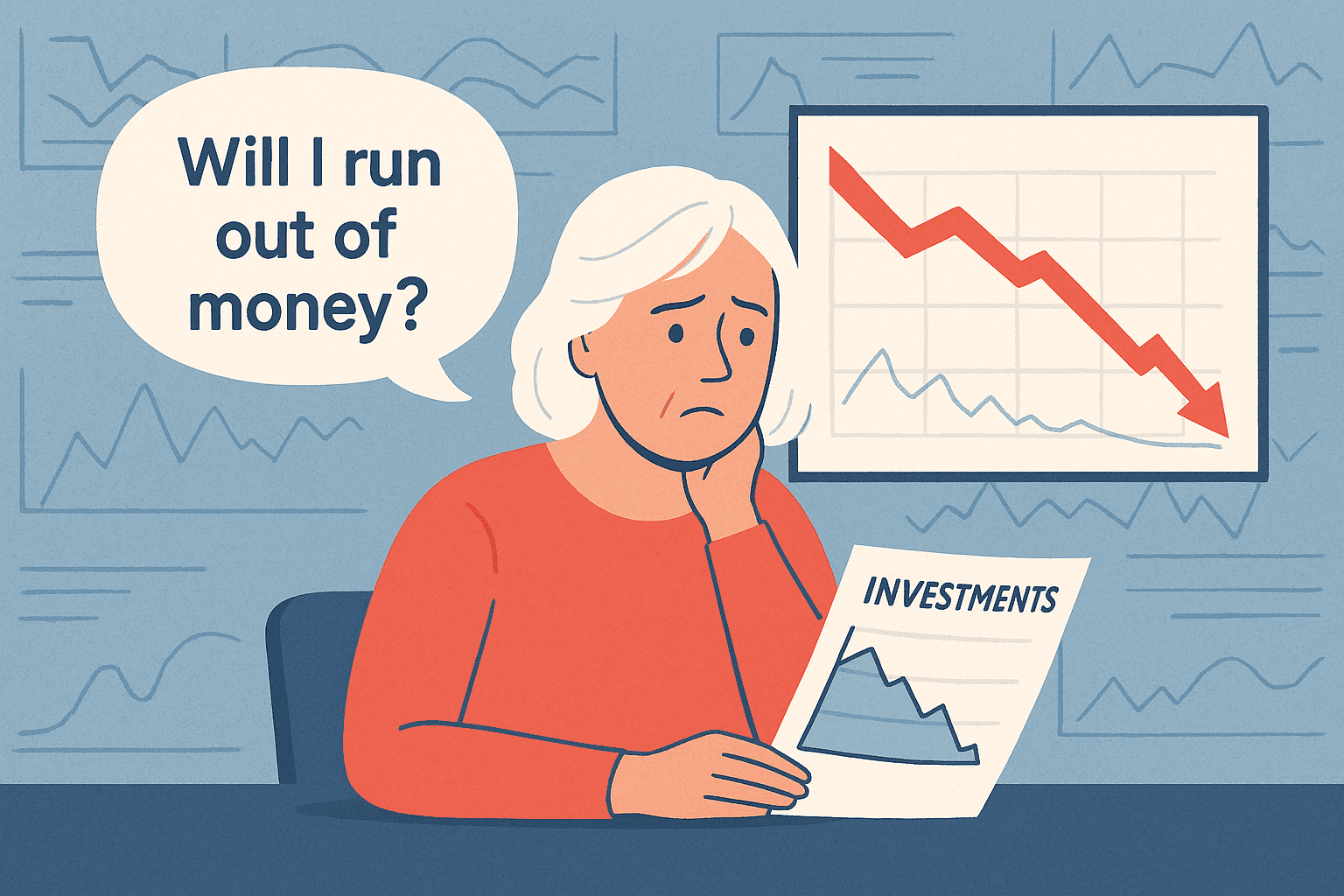
When most people think about investment risk, they imagine scary headlines and sudden market drops. But if you’re nearing or in retirement, there’s a much more pressing question:
“Will I run out of money?”
It’s not about volatility—it’s about longevity risk. And while traditional portfolio approaches focus on beating benchmarks, that’s not what really matters to you.
Let’s look at a smarter, more human-centered way to plan your retirement income—one that actually answers the questions you’re asking.
The #1 Retirement Fear: Running Out of Money
Based on surveys and decades of financial planning experience, here’s what retirees actually fear:
- Spending too much early on and outliving their savings.
- Spending too little and missing out on the retirement they worked so hard for.
Overspending might eventually force someone to move in with their kids. Underspending might mean a life of unnecessary frugality. Neither is ideal.
The challenge is finding a balance—spending confidently and sustainably. That starts with changing how we measure “risk.”
Benchmarks Miss the Point
Most financial plans track performance against stock or bond indexes like the S&P 500 or Bloomberg Aggregate. But benchmarks can’t tell you:
- “Can I afford to retire next year?”
- “Can I take that trip to Italy?”
- “Do I need to adjust my spending if the market dips?”
That’s where the concept of the Critical Path comes in—a better way to track your retirement plan against your actual goals, not some market average.
The Critical Path: Borrowed from NASA, Built for Retirement
The term “Critical Path” comes from the Apollo space missions. Engineers knew exactly where the rocket needed to go—even if it drifted off course 95% of the time, they continually made corrections to get it back on track.
We use this same idea in retirement planning. Your Critical Path starts at retirement, ends when the plan ends (maybe 30+ years later), and shows you whether your portfolio is on pace to meet your needs year by year. If it’s off track, we adjust.
This keeps the focus on your goals, not just market performance.
3 Common Retirement Income Approaches—and Their Flaws
1. Systematic Withdrawal
The classic 60/40 portfolio, drawing down a fixed percentage each year. It’s simple, but vulnerable to poor market returns early in retirement (known as sequence risk).
2. Bucketing Strategy (not the same as The Bucket Plan® by the way)
Divides money into short-, medium-, and long-term “buckets.” It’s intuitive, but can lead to inefficient use of cash and overly rigid allocations.
3. Income Flooring
Uses annuities or inflation-protected bonds to guarantee lifetime income. It’s secure—but expensive, and often impractical for full lifestyle funding.
The Approach I Use: The Bucket Plan: Asset Dedication + Critical Path
The strategy I use with clients combines the best of all three approaches. It’s called Asset Dedication, or The Bucket Plan®.
We break your retirement portfolio into two pieces:
🔒 1. Soon Bucket Income Portfolio
We might build a “ladder” of individual bonds, or use a enhanced-liquidity fixed investment like an Indexed Annuity to match 5–10 years of your projected spending. With the ladder, each year’s income is matched to a bond that matures at the right time.
Whether with bonds or an annuity, this portion is immunized from market volatility. It gives you a runway of predictable cash flow—even if markets are rough.
📈 2. Later Bucket Growth Portfolio
The rest is invested for long-term growth (e.g. equities, alternatives). This portfolio is designed to replenish the income portion over time—but only when markets are favorable.
Because we’re not relying on it for income right away, we can let it breathe and complete a market cycle without pressure.
Why It Works—For You and Your Life
This approach works because it’s:
- Behaviorally aligned: You can see where your income is coming from, and how it connects to your plan.
- Risk-aware: It reduces exposure to early market losses (sequence risk).
- Flexible: As your life evolves, we adapt the plan. Want to take a trip or adjust your withdrawals? We’ll see if your trajectory supports it.
The math behind it is precise, but the feeling it provides is clarity and confidence.
Final Thoughts
If you’re retired—or planning to be soon—you need more than an off the shelf “set it and forget it” portfolio.
You need a plan that’s personalized, adaptable, and grounded in the realities of life—not just market statistics. That’s what the Critical Path + Asset Dedication approach delivers.
It’s not about beating the market. It’s about staying on track for your life.
If you’d like to explore how this strategy could work for your retirement, let’s talk. The first step is a 20-minute conversation to see if we’re a good fit.
You’ve worked too hard to leave retirement up to chance. Let’s build a plan that actually gets you where you want to go.