
Retirement income
Dave Ramsey Is Right About Stocks. But Is He Right About Annuities?
Nigel Valdez · Certified Financial Fiduciary® (CFF®), Federal Retirement Consultant (FRC®)
Why the real value of a fixed indexed annuity may have little to do with the annuity itself
A word before we start
I am not a fan of annuities. I’m not against them either. I’m about as fond of them as I am of any other investment, which is to say it depends entirely on the job.
I mention this because annuities, more than almost any other financial product, come with opinions pre-installed. I’ve watched people dismiss them with a harshness they would never apply to a bond fund, and I’ve watched others embrace them with an optimism no product has earned. Both reactions skip the part that matters.
An annuity is just another asset class, with its own problems and its own advantages. Like every asset class, it has a specific niche where it does something nothing else does quite as well, and a great many places where it has no business being. The question is never whether annuities are good or bad. It’s whether this one has a job in this plan.
I am a fan of Dave Ramsey. Dave has done more to get ordinary families out of debt and into the habit of investing than almost anyone in American personal finance. Discipline, simplicity, patience, equities for the long run: he has been teaching the right things for a long time, and a great many people are better off for having listened. I’m one of the people who thinks so.
He also doesn’t like annuities. He has said so repeatedly, warning investors about their costs, complexity, limited returns, and restrictions on accessing their money.
On much of this, he’s right. Not every annuity is a good financial product, and not every retiree needs one.
But there’s a problem with treating an entire category of financial instruments as inherently unsuitable: it overlooks what those instruments might accomplish as part of a larger retirement plan.
In fact, when it comes to certain fixed indexed annuities, I’d suggest the question Ramsey asks is narrower than the question a retiree needs answered.
The real question isn’t how much an annuity can earn compared with the stock market. It’s what role the annuity can play in allowing the rest of a retirement portfolio to grow.
And this approach begins where Ramsey and I agree completely: equities are among the best vehicles for building long-term wealth.
The challenge is keeping that wealth invested for growth while simultaneously using it to fund retirement.
The Retirement Problem That Changes Everything
During our working years, investing is relatively straightforward. We regularly contribute to retirement accounts, invest for the long term, and generally try to avoid letting short-term market movements influence our decisions.
But retirement introduces a new challenge.
Now we’re no longer just accumulating assets. We’re withdrawing from them.
And that changes the mathematics considerably.
Imagine a retiree with $1 million invested in the stock market. She plans to withdraw $40,000 annually to supplement her Social Security and pension income.
Now imagine the market declines 30% shortly after she retires.
Her $1 million portfolio is suddenly worth $700,000, even before accounting for withdrawals. Yet the bills still need to be paid. She continues selling investments to support her lifestyle, potentially locking in losses and reducing the number of shares available to participate in the eventual recovery.
Take the year’s $40,000, which she needs, out on top of the loss, and the portfolio stands at $660,000. From $1 million to $660,000, in one realistic but bad year.
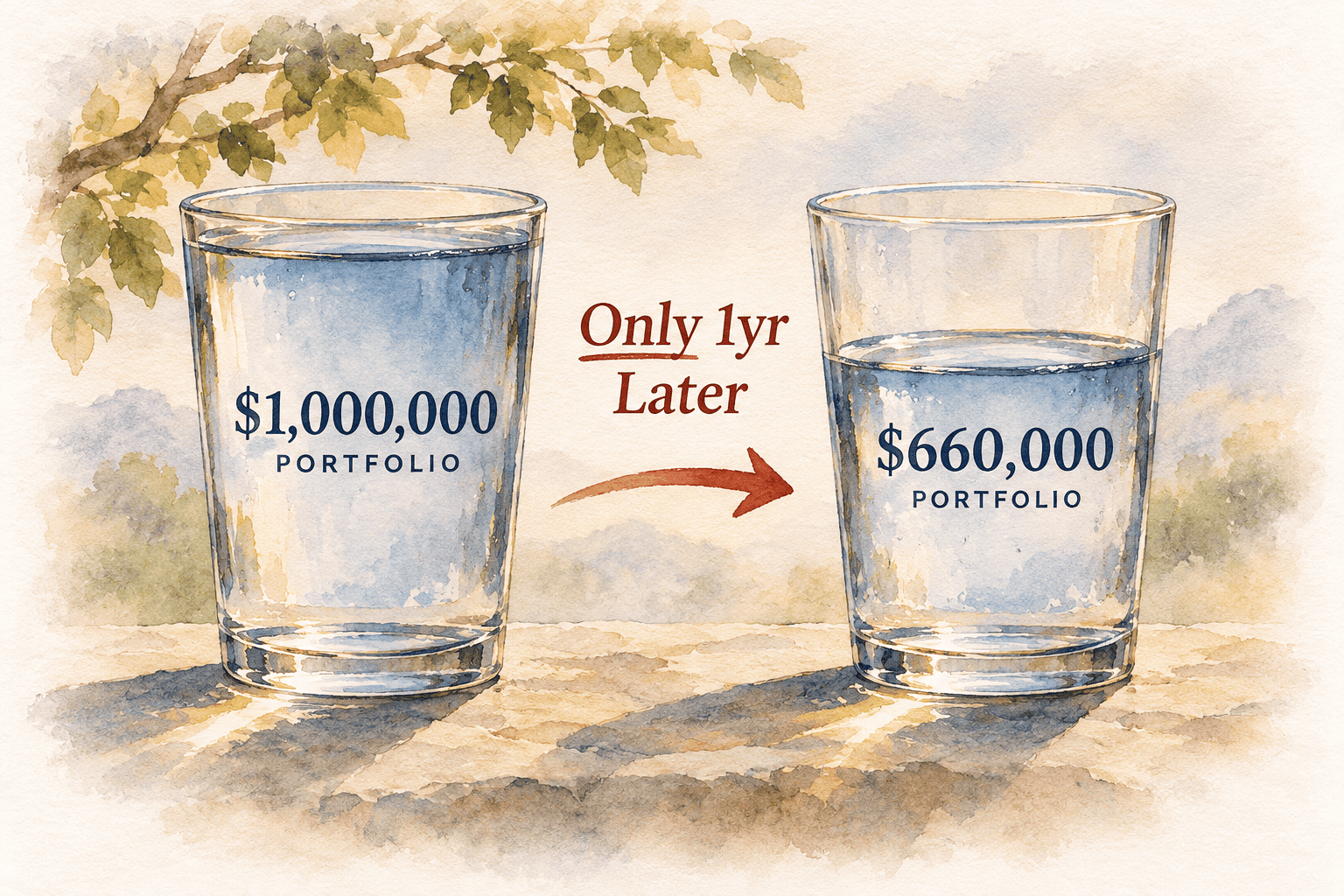
This is called sequence-of-returns risk. And annuities can potentially protect you from it.
Unlike market volatility during the accumulation years, losses early in retirement can cause lasting damage because withdrawals compound their effects. Even strong market performance later may not fully repair the damage.
A portfolio can earn respectable average long-term returns and still fail to provide sustainable retirement income.
This is one reason retirement-income planning requires a different approach from retirement saving.
And it’s where a blanket rule about annuities starts to cost something.
The Problem with ‘Silo’ Thinking
One of the most common mistakes in financial planning is evaluating investments individually, without considering how they work together.
I call this silo thinking.
An investor looks at a particular investment and asks: How much does it earn? What does it cost? Is there something else that could earn more?
These are reasonable questions, but they are incomplete.
In retirement, an investment’s value isn’t determined solely by its individual return. It also depends on the purpose it serves and how it interacts with the rest of the portfolio (and the IRS, while we’re at it).
A cash reserve, for example, may generate lower returns than stocks. But its purpose isn’t to outperform stocks. It is to provide liquidity and stability.
Similarly, insurance may not offer an attractive expected financial return, but that doesn’t make it inherently wasteful. Its value comes from transferring a risk we would otherwise have to bear ourselves.
Certain fixed indexed annuities deserve to be evaluated through that same lens.
When an FIA is dismissed because it cannot compete with the stock market’s long-term growth potential, that is precisely this kind of silo thinking.
He evaluates the product in isolation rather than examining what it might contribute to a coordinated retirement strategy.
An asset that earns less individually can sometimes help the overall portfolio, and therefore the household, function better.
That is the critical distinction.
Two Buckets, Two Different Jobs
Consider a retirement portfolio divided into two broad categories based on when the money will be needed.
The Soon Bucket contains assets designated to support planned withdrawals during the nearer years of retirement.
Its primary purpose is protection and dependable access to funds, rather than maximizing investment returns.
The Later Bucket contains assets intended for the more distant future.
Because this money isn’t needed to support immediate spending, it can be invested with a longer time horizon, emphasizing diversified equities and long-term growth.
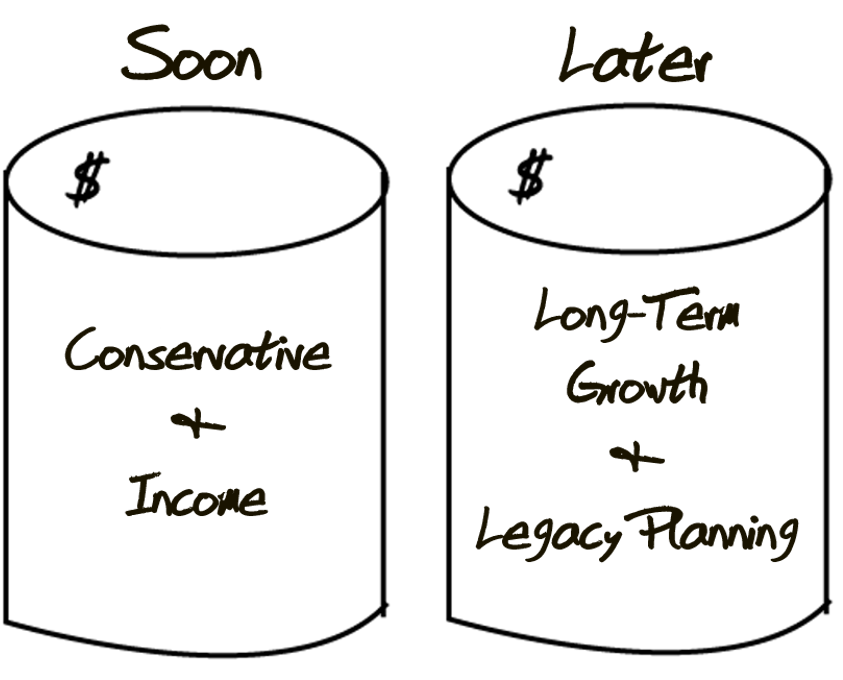
The value of this arrangement is the coordination between the two buckets.
If the retiree knows that planned near-term withdrawals can be funded without selling equities, the Later Bucket can remain invested through periods of market volatility.
The retiree is less likely to be forced into selling stocks during downturns, potentially allowing more shares to remain invested and participate in a recovery.
This does not eliminate market risk. Nor does it guarantee superior long-term performance. Eventually, the Soon Bucket may need to be replenished, and those decisions must be coordinated carefully.
But it addresses one of retirement’s most difficult challenges: how to pursue long-term growth while simultaneously generating a dependable stream of withdrawals.
The two objectives no longer need to compete for every dollar in the portfolio.
Where a Fixed Indexed Annuity Fits
This is where a carefully selected fixed indexed annuity can become useful: as the protected, accessible source of money the Soon Bucket needs.
Not every FIA is appropriate for this purpose. Some are expensive, restrictive, or unnecessarily complicated.
But consider a particular type of FIA designed for protected accumulation and enhanced access to funds.
Such a contract may provide several meaningful guarantees:
- Protection from market losses: The contract’s accumulation value is protected against declines in the referenced market index, including protection of previously credited interest.
- The opportunity for additional growth: Interest can be credited based on positive index performance, subject to the contract’s formulas and limitations.
- No annual product fee: Certain contracts charge no explicit annual product fee, although their interest-crediting terms still reflect the insurer’s economics.
- Enhanced liquidity: Some contracts allow annual penalty-free withdrawals of up to 10% of the original premium or accumulation value, whichever is greater, after the initial waiting period.
That last provision deserves attention.
In contracts where the annual withdrawal allowance is based on the greater of original premium or current accumulation value, the calculation isn’t automatically reduced as the account balance declines.
For a retiree using the contract to fund planned withdrawals, this can provide a valuable degree of predictability.
These guarantees are contractual obligations of the issuing insurance company, subject to its financial strength and claims-paying ability. They are not guarantees of high investment returns, and withdrawals still reduce the contract’s value.
But investment returns aren’t the primary reason for owning this type of annuity.
Its purpose is to provide a protected, accessible source of money for the Soon Bucket.
An Example: $1 Million, Working Together
Now imagine a retiree with the same $1 million as before, taking the same $40,000 a year to supplement other retirement income.
One possible strategy: $500,000 in the Soon Bucket, held in a carefully selected fixed indexed annuity, and $500,000 in the Later Bucket, invested for long-term growth.
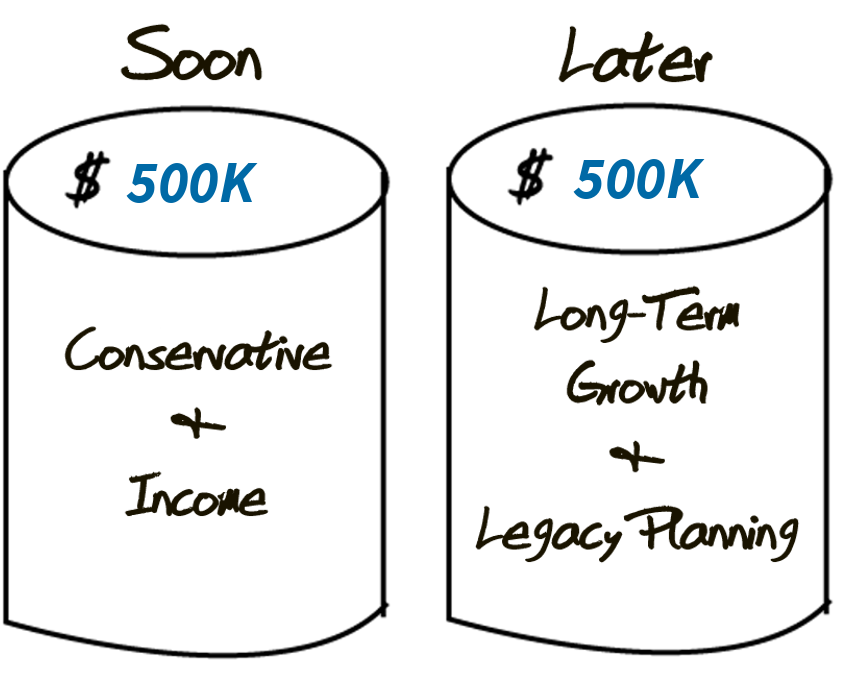
If the annuity allows it, the retiree can take up to $50,000 a year from the Soon Bucket without penalty. The planned $40,000 fits comfortably inside that.
The $50,000 is what the contract allows, not what the Plan says to spend. The $40,000 comes from the Plan, and every withdrawal reduces what the annuity holds.
But here’s the important part.
The Later Bucket $500,000 doesn’t have to fund any of it. It can stay invested for growth.
If the market falls sharply, withdrawals continue from the protected Soon Bucket. No depressed stocks have to be sold.
If the market does well, the Later Bucket is there to benefit.
Over time, the Plan determines when and how the Soon Bucket should be replenished.
The point isn’t that the annuity will outperform the stock market. It almost certainly won’t during a sustained bull market.
The point is that the annuity can help the other Later Bucket investments remain in the market long enough to pursue the returns for which they were selected.
That is the potential value of the arrangement, and it is a benefit that simply comparing the FIA’s interest credits with stock-market returns fails to capture.
A Built-In Measure of Spending Discipline
A well-designed retirement-income plan establishes how much a retiree can reasonably spend, taking into account pensions, Social Security, investment assets, taxes, inflation, and other considerations.
But following that plan consistently can be difficult.
In good markets, retirees may feel wealthier and be tempted to withdraw more. In bad markets, anxiety can cause them to abandon an otherwise sound strategy.
A designated Soon Bucket introduces structure.
The retiree knows which Soon Bucket assets are intended to fund regular spending and has an established withdrawal target.
The annuity’s contractual withdrawal provisions can reinforce that discipline by establishing a natural boundary around annual access.
These are gentle guardrails, not rigid restrictions. Additional withdrawals may be available, although amounts exceeding the contract’s free-withdrawal allowance can incur charges during the surrender period.
The purpose isn’t to prevent retirees from enjoying their money.
It is to help them spend confidently and deliberately, according to a plan designed to last.
The Surprising Agreement With Dave Ramsey
This brings us back to Ramsey.
His preference for equities as long-term growth investments is not where I disagree with him.
In fact, that belief is central to the strategy I’ve just described.
The Later Bucket should be positioned to capture long-term market growth, consistent with the retiree’s circumstances and risk tolerance.
Where we part company is in how to manage the risks associated with withdrawing money from investments during retirement.
Ramsey’s broad criticism of annuities tends to focus on what investors give up: market upside, immediate liquidity, and flexibility.
Those are important tradeoffs.
But the proper analysis must also consider what the investor gains—not merely inside the annuity, but throughout the entire portfolio.
A protected source of near-term withdrawals can reduce the need to sell growth investments during market declines. It may also make a retiree more comfortable maintaining meaningful equity exposure during difficult periods.
In other words, protecting one portion of the portfolio may create greater freedom to pursue growth with another.
Evaluating those two portions separately misses the point.
This is why coordinated retirement-income planning matters:
The Value Is in the Plan, Not the Product
Of course, an FIA isn’t the only way to construct a protected Soon Bucket.
Cash reserves, Treasury securities, CDs, and high-quality bond ladders can serve related purposes, each with its own advantages and limitations.
Nor is an FIA appropriate for every retiree.
The product’s interest-crediting terms, surrender period, liquidity provisions, insurer strength, opportunity costs, and other contractual conditions must be carefully considered.
Even a contract with no explicit annual fee can be an inappropriate choice if it doesn’t serve a genuine planning need.
For federal employees, the analysis is particularly important. A FERS or CSRS pension, together with Social Security, may already provide substantial dependable income. That can change how much additional protection is useful and how the remaining investments should be allocated.
But these decisions cannot be made by evaluating each asset in isolation.
They require understanding how all the pieces fit together.
How much income is already guaranteed? How much additional income must the portfolio supply? How much should be protected for near-term withdrawals? How long can the remaining assets stay invested? And how will the plan respond when markets inevitably behave differently than expected?
Those are planning questions, not product questions.
A well-designed retirement strategy begins by answering them, then selects the appropriate financial instruments to accomplish the objectives.
Sometimes that includes a fixed indexed annuity.
Sometimes it doesn’t.
And that is precisely why blanket rules about entire categories of financial products, however well-intentioned, can fall short.
Sophisticated Planning, Simple Retirement
Dave Ramsey has done an enormous service by making sound financial habits accessible to millions of Americans.
His emphasis on discipline, simplicity, and long-term investing deserves respect.
But there’s an important difference between simplicity and oversimplification.
Retirement investing isn’t merely accumulation investing with withdrawals added. It introduces new risks, objectives, and tradeoffs that deserve to be addressed deliberately.
And a financial instrument shouldn’t be judged only by its individual return when its primary contribution may be to improve the way other assets are used.
The most effective retirement-income strategies often combine assets with very different characteristics, assigning each a specific purpose.
Some protect near-term spending. Others pursue long-term growth. Together, they form a coordinated strategy that can be more resilient than either approach on its own.
That’s the larger lesson.
The real value isn’t necessarily in the annuity. It’s in the plan that gives the annuity its purpose—and frees the rest of the portfolio to do what it does best.
Fixed indexed annuities are insurance contracts. Guarantees depend on the issuing insurer’s financial strength and claims-paying ability. Interest credits are subject to contractual terms and may be zero in some periods. Withdrawals reduce account value, and surrender charges or other adjustments may apply. No-annual-product-fee contracts may still involve implicit economic costs. Retirement-income strategies, including bucket approaches, do not eliminate market risk or guarantee successful outcomes. The appropriate allocation and withdrawal strategy depend on individual circumstances.
About the author. Nigel Valdez is a Certified Financial Fiduciary® (CFF®) and Federal Retirement Consultant (FRC®) at Better Federal Retirement®, a fee-based advisory practice for federal employees and retirees. He has worked in financial services since 1998 and writes regularly for FedWeek and FedSmith. Book a call →



Leave a Comment